Building A Spotlight Video From A Live AI Workflow
A Morning Scrum field note on using AI to produce a Strattegys Spotlight package, and building the missing production tools as the work unfolded.
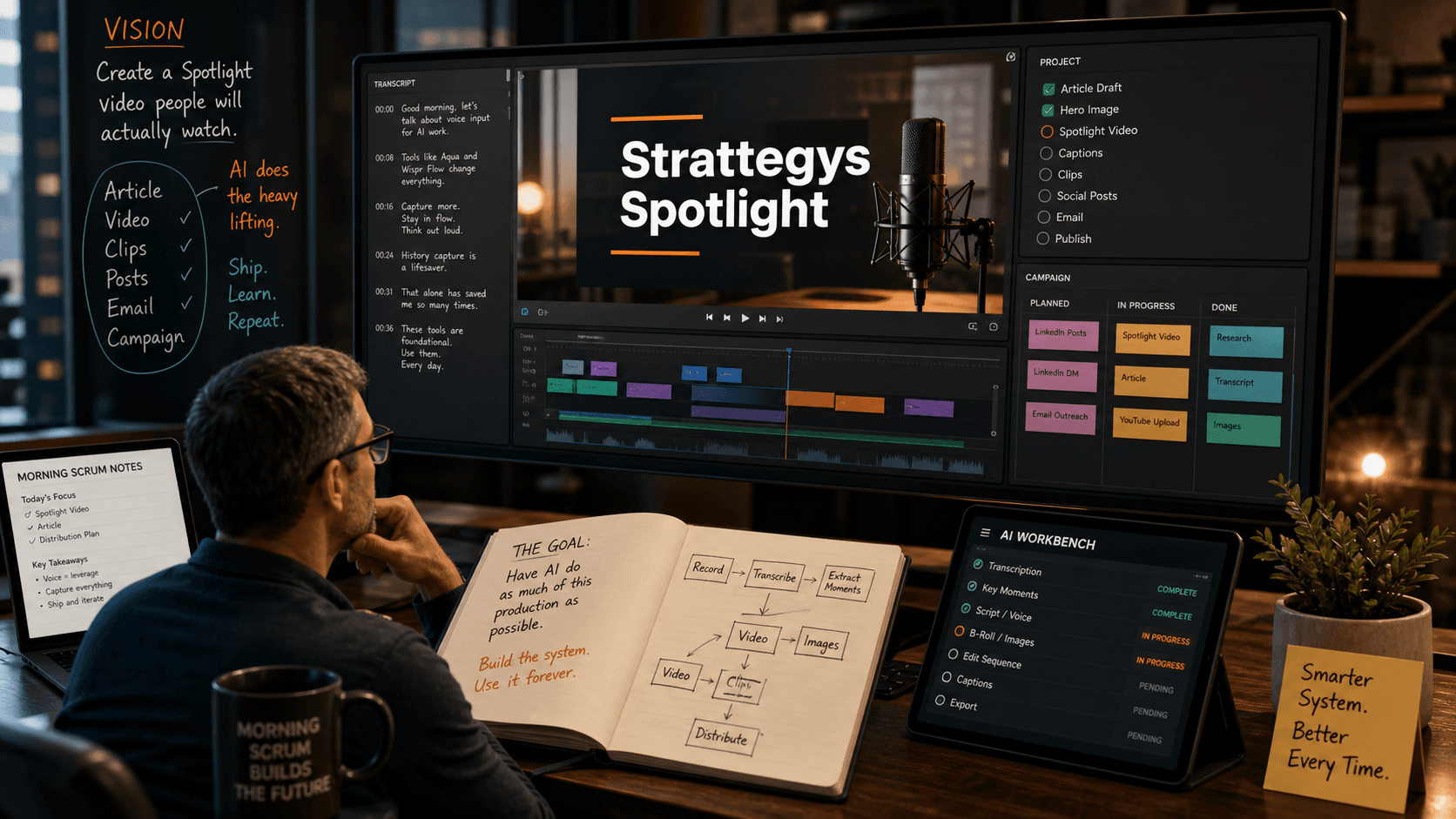
I used Morning Scrum to test a bigger idea: could AI help produce the full Strattegys Spotlight package, including the article, video, images, clips, and campaign workflow? The messy part was discovering which tools did not exist yet, then building them as the work unfolded.
This started with a pretty simple idea.
I wanted to use my Morning Scrum time to produce a Strattegys Spotlight video.
Not a huge production. Not a polished studio piece. Just a useful, sharp little video that could support a Spotlight article and show the idea in motion.
And when I say Spotlight, I mean the Strattegys Spotlight workflow: take a real piece of expertise, turn it into a focused article, create supporting media around it, and then build the distribution package that helps the idea travel. It is not just "write a blog post." It is article, video, images, LinkedIn, email, outreach, and campaign execution wrapped around one clear idea.
That is the ambition.
The topic was voice input for AI work. Tools like Aqua and Wispr Flow. The point was that if you are doing a lot of AI work, voice is not just a convenience. It becomes part of how you operate.
That part made sense.
The harder part was everything around it.
How do I take a live working session and turn it into a video? How do I pull out the right clips? How do I add voiceover? How do I add captions? How do I bring in article images? How do I make it feel like a real Spotlight asset instead of a rough screen recording?
That is where the whole thing got interesting.
Because the goal was not for me to manually produce all of that.
The goal was to see how much of it AI could do.
And that means I was asking AI to do things I had not necessarily asked it to do before. Not just write copy. Not just summarize a transcript. I wanted it to help produce the actual asset: choose clips, work from transcripts, build visual sequences, use article images, create captions, prepare the video, place it in the article, and keep the campaign organized.
I had a vision for something that was bigger than the workflow I actually had.
And that is usually where the real work starts.
The Gap Between The Vision And The Tools
I could see what I wanted.
I wanted a video that could sit inside the article and make the whole thing feel more complete. Something short. Something useful. Something that showed the point without making the viewer sit through a long raw recording.
And I wanted to be part of it. That matters. A Spotlight should not feel like an anonymous AI explainer with generic stock motion. It should carry the voice and presence of the person behind the expertise. If the article is built from my working knowledge, the video should still feel connected to me.
But I did not really have the whole production path worked out.
I had pieces.
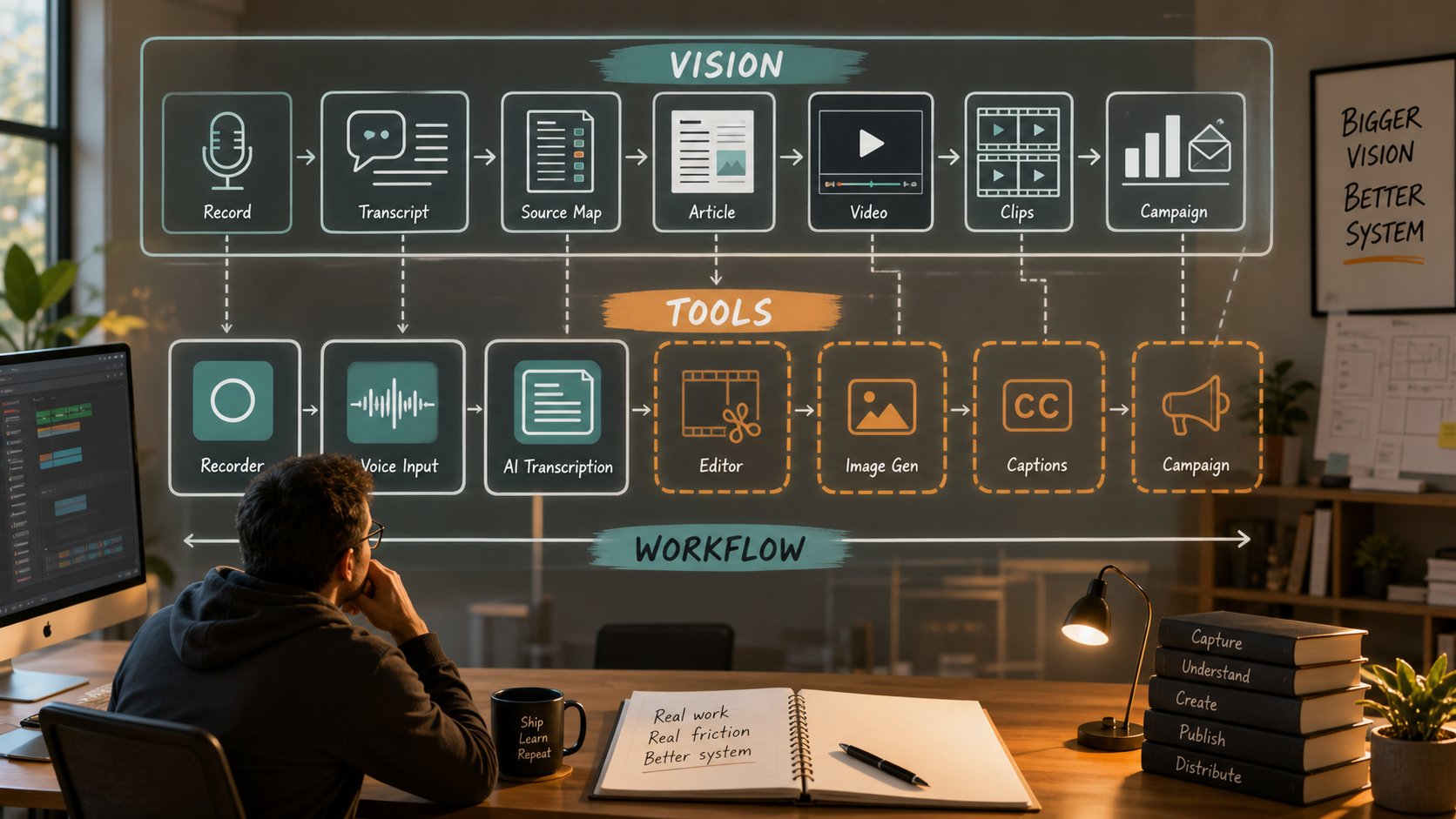
I had OBS. I had the recording. I had the article. I had AI tools. I had Command Central. I had image generation. I had some video editing scripts. I had a rough idea of how this should all connect.
But having pieces is not the same as having a workflow.
That is the part I keep running into with AI.
AI makes you more ambitious almost immediately. You can suddenly imagine producing things that used to require a much bigger team. A written article. A supporting video. Social posts. Images. Clips. Email. Campaign follow-up.
You can see the whole system in your head.
Then you try to actually do it, and all the missing pieces show up.
The captions are in the wrong place. The clip is not quite right. The voiceover does not feel right. The video player covers something. The article needs another image. The artifact is hard to find in the planner. The campaign card needs a refresh button. The source has to be transcribed before the draft is actually any good.
It is not failure.
It is the workflow telling you what it needs next.
The Video Forced The System To Improve
The Spotlight video became a forcing function.
At first, I thought maybe I should just record a cleaner version. Then I wondered if I should skip recording and make more of an explainer video. Then I thought about using a character or voiceover. Then I wanted to use article images. Then I wanted to include a real clip of me because that gave it credibility.
Every decision created another dependency.
If we use clips, we need transcripts.
If we use transcripts, we need fast transcription.
If we use article images, we need a way to generate and manage them.
If we use voiceover, we need a voice that fits the world.
If we put the video in the article, the article needs a clean embed.
If we manage all of this in Command Central, the campaign view needs to show the artifacts clearly.
That is how the work unfolded.
I was not just making a video. I was discovering the production system required to make that kind of Spotlight repeatable.
That is the part I care about.
Because once the tools exist, they do not only exist for this one Spotlight.
They become available for the next one.
Real AI Work Is Bumpy
This is the thing I want to be honest about.
Real AI work is bumpy.
It is not just a perfect prompt and a perfect output.
It is a lot of weird in-between work. You have to decide what the asset is. You have to figure out whether the recording is usable. You have to realize local transcription is too slow. You have to send the audio to AI. You have to revise the draft because the first version feels too packaged. You have to move captions. You have to cut clips differently. You have to make the UI show the artifact so you can even review it.
That sounds messy because it is messy.
But it is also how the system gets built.
Every snag exposes a missing tool.
And with AI, that is a big deal. Because when you create the missing tool, you do not just solve the immediate problem. You add a new capability to the whole workflow.
The first time is slow because you are building the path.
The second time is faster because the path exists.
The third time, it starts to feel normal.
That is the breakthrough.
The Spotlight Article Was The Anchor
The finished Spotlight article gave the whole workflow something to orbit around.
The article is here:
The Voice Layer Behind Real AI Production Work
That article makes the core argument about the voice layer of AI work. It talks about tools like Aqua and Wispr Flow as examples of a broader capability: getting human intent into AI systems faster and more naturally.
The video did not need to repeat the whole article.
It needed to support it.
That distinction helped.
The article could do the thinking. The video could give the idea some motion. The clips could create entry points for LinkedIn. The campaign work could turn the whole thing into distribution.
Each asset gets a job.
That is a much better way to think about this than trying to make one giant piece of content do everything.
The Tooling Becomes The Product
The more I worked through this, the more obvious it became that the internal tooling is not separate from the content.
The tooling is part of the product.
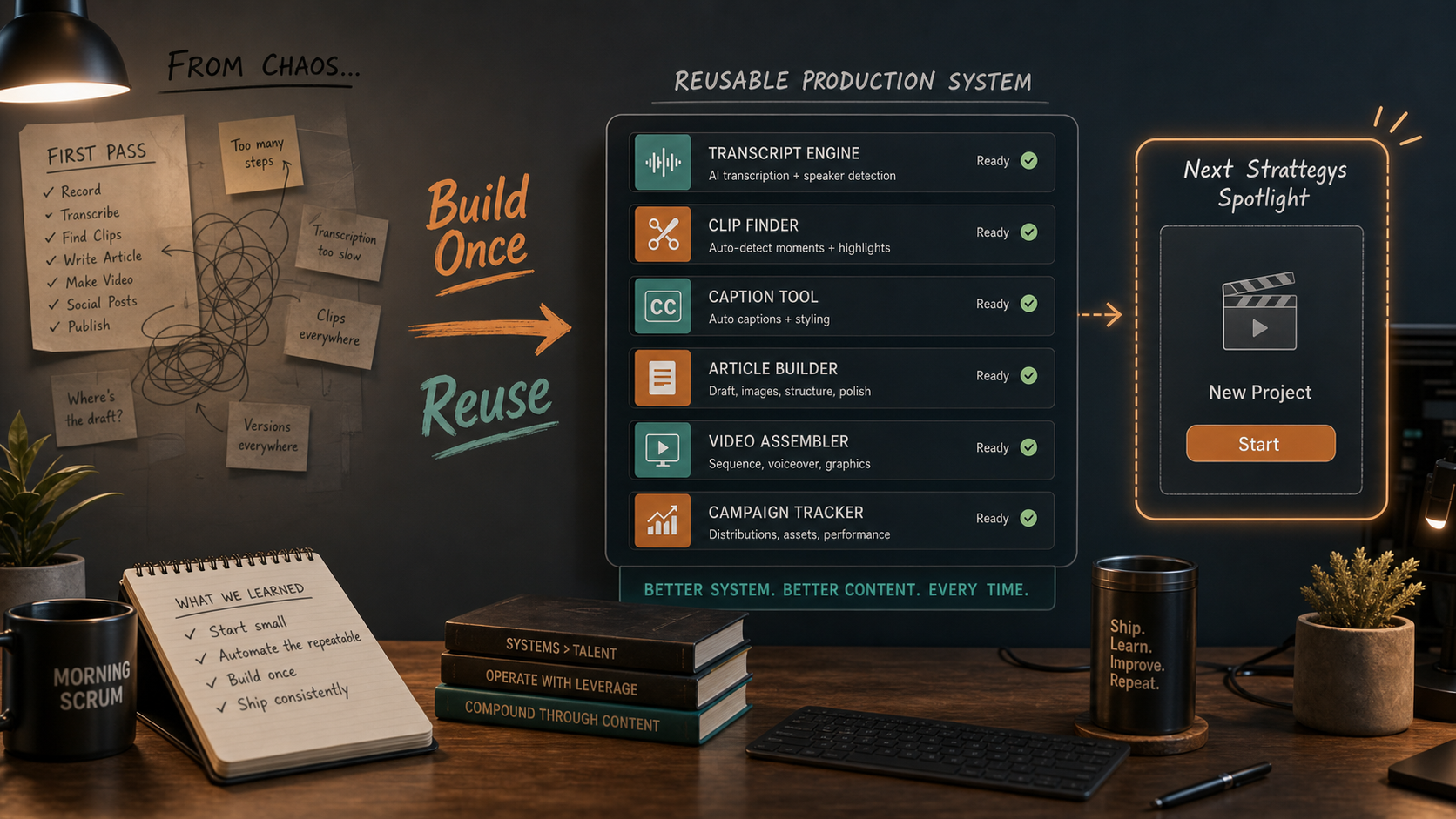
Command Central is not just a place to store tasks. It is the workbench. It is where the production gets organized. It is where the campaign setup, distributions, artifacts, executions, and human review all need to come together.
If I cannot see the draft, the video, the images, the transcripts, and the next actions in one place, the workflow feels scattered.
So the process of making the Spotlight video forced improvements to the workbench.
We needed artifact visibility.
We needed a focused campaign URL.
We needed a refresh button.
We needed the transcripts attached to the right setup work.
We needed the article draft connected to the blog distribution.
These are small pieces, but they matter.
They are the difference between "AI helped me make a thing once" and "I now have a better production system."
The Bigger Vision Is Still Ahead Of The Current Tools
I think this is important.
My vision is still bigger than what I can do cleanly today.
I can see the system I want. I want to be able to record a real working session, have AI capture the important moments, build a clean article, generate or select the right images, produce a supporting video with me in it, create clips, publish to the site, and organize distribution without losing the thread.
That is the vision.
We are not fully there yet.
But we are closer than we were before this pass.
And that is what makes this exciting.
The point is not that this Spotlight video process was perfect. It was not.
The point is that the process created new tools, new conventions, and a clearer path for the next one.
That is how I think serious AI work is going to happen for a while.
You aim slightly beyond your current capability.
You hit friction.
You build the missing tool.
Then that tool becomes part of the permanent system.
What We Got Out Of It
At the end of this, we had more than a rough experiment.
We had a published Spotlight article. We had AI-generated images. We had a supporting video direction. We had transcripts. We had a clearer campaign structure. We had a better artifact viewer. We had a refresh control. We had a better understanding of what the article should be and what the video should be.
That is a lot.
And it came from pushing into the gap between what I wanted to produce and what the workflow could already support.
That is the part I want to keep doing.
Not because it is smooth.
Because every time we do it, the system gets stronger.
The Real Lesson
The real lesson is not just that AI can help make an article or a video.
Of course it can.
The real lesson is that AI lets you build the production system while you are producing.
That changes the whole feel of the work.
You are not just using tools.
You are making tools.
You are not just shipping content.
You are improving the machine that ships the next piece of content.
That is what happened here.
I wanted to make a Spotlight video. I ran into the limits of my workflow. Then those limits became the roadmap.
And now the next Spotlight gets easier.
Dispatch
Get the next field note
New articles, show notes, and practical lessons from the Strattegys AI crew.
 Morning Scrum
From Dev to Production: The Real Workflow for AI Agents
AI production is not just taking a Codex session and asking it to do the same thing fifty times. The workflow gets shaped in Session with Codex, then the repeatable parts move into faster, tighter production surfaces powered by bound tools and models like Groq.
 Spotlight
See How AI Changes the Calculus for GTM Strategy
Explore a real-life Mirror Teams strategy session showing how AI lowers the barriers to comparing options, testing assumptions, and turning market analysis into executable work.
 Spotlight
Session Terminal: A Workspace for Persistent AI Work
The command line is still the fastest lane into AI work. But once you run multiple agents, the real problem becomes drift: lost purpose, hidden status, fragile recovery, and context scattered across too many surfaces.