Passing Messages Between My Agent and Claude Code
My AI agent told me it couldn't do what I asked. So I copied its message, pasted it into Claude Code, and let them figure it out through me. Ten tests later, it worked. The whole experience completely blew my mind — and it's simpler than you'd think.


I rolled in this morning, fixed some things, and tried to get Tim to set a reminder in Slack.
And that’s where everything got interesting.
See, I wanted to set a reminder and have the agent do it. And I went through a little learning there about how reminders actually work. I had it all ready to go — pretty straightforward — and then I stopped and was like, no. I don’t want Tim to do that. That’s gonna be called Suzi bot.
That realization is more important than it sounds.
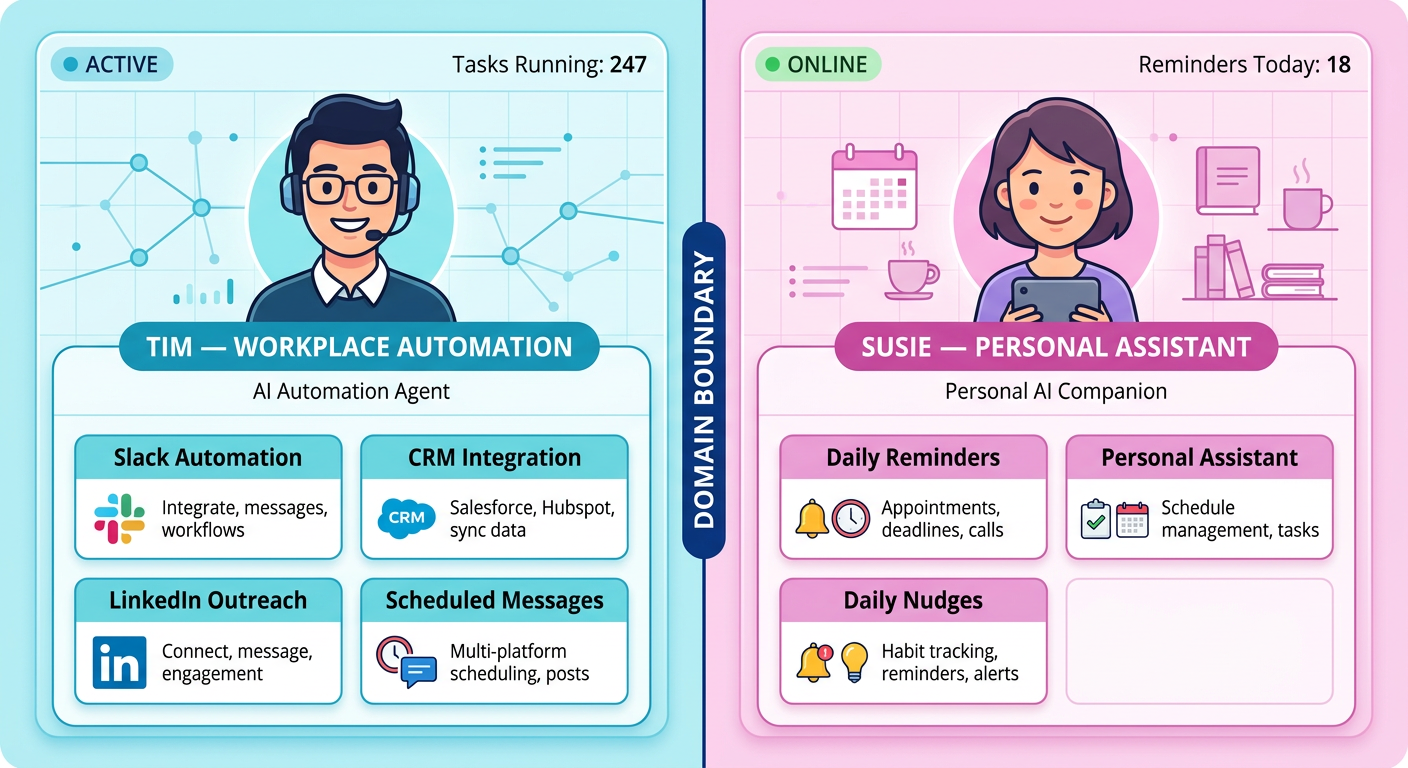
Defining the capabilities and what you give each agent — what their domain is — is actually one of the most important things in creating an effective agent.
Tim handles outbound, CRM, LinkedIn, scheduled messages. Suzi’s gonna be more of a personal assistant — reminders, nudges, daily rhythm stuff. Two agents, two domains, zero confusion.
And once I add her, I’ll enable that. But I’m not rushing it. I’m building into it deliberately.
So here’s the experience that completely blew my mind today.
I said to Tim, hey, set a reminder for me at 10 AM. Tim comes back and says, I can’t do that.
I don’t have a way to do that. At first I’m like, okay, what’s going on?
And then there was a bunch of CI/CD stuff that wasn’t quite right, and I’d made a mistake — I had the wrong folder I was working in when I created a piece of this.
You know, sometimes you wake up in the morning and start working on something, and you do have to be careful in Claude Code that you’re working in the right place. I had to reset my SSH key. There was a timing issue.
There were like eight issues that had to be fixed.
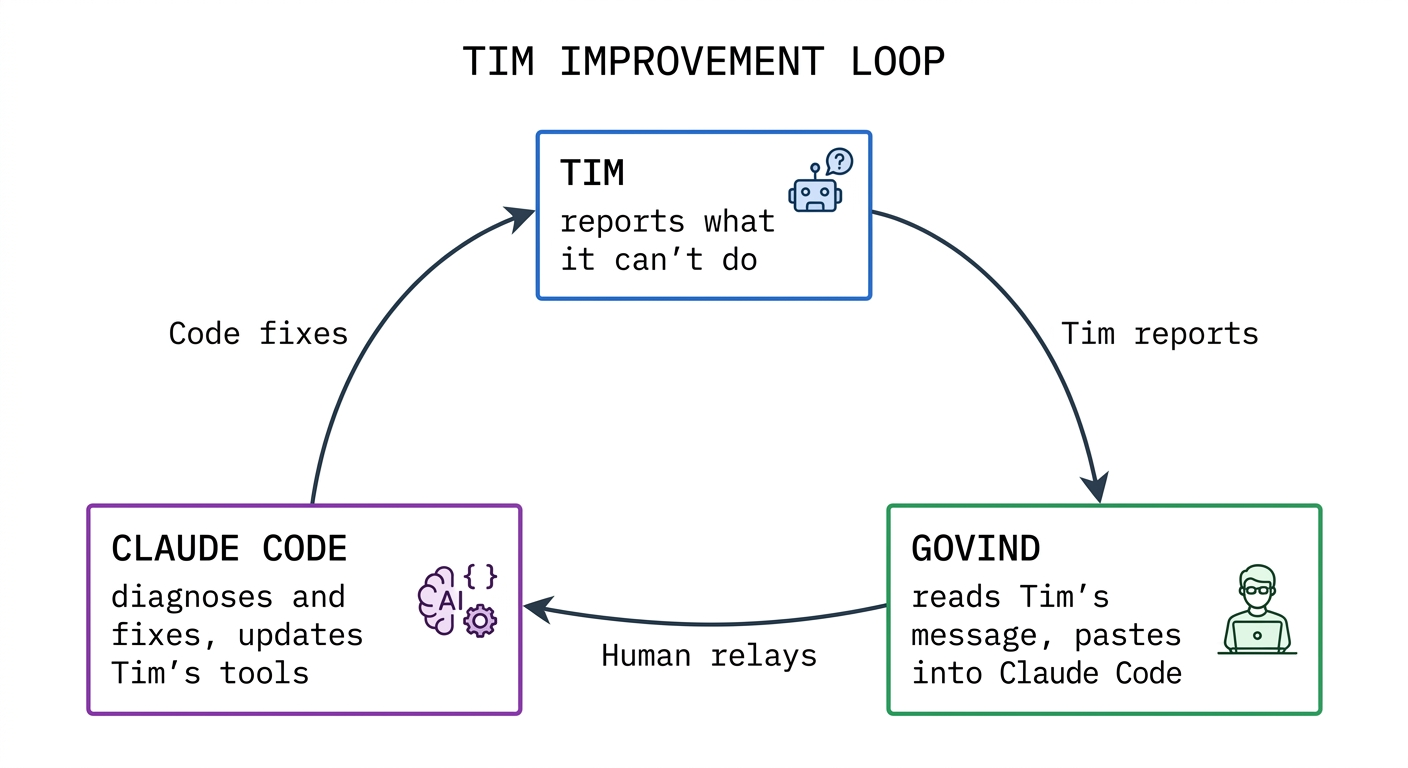
So here’s what I was doing. I’m over in Claude Code, and I’m literally just pasting in — here’s what Tim says.
Like, Tim said blah blah blah blah blah.
I don’t really want to decipher that and even have to give any kind of command to Claude Code. I’m just literally passing the messages back and forth.
Now, people who are super smart, they’re like, oh, let’s wire this up and they’ll talk to each other and continuously fix each other. And I’m sure there’s people doing that. But this pattern — this basic pattern of the agent telling you what’s happening, and then you go to your coder, whatever tool you’re using to control the agent, and you just pass the messages back and forth — that’s a great human-in-the-middle approach for me.
It works really, really well.
It took maybe five, six, ten tests. Edge cases kept coming up — a timing issue here, an auth permission there. Each time, same loop. Each time, closer to working. And then it just worked.
I was like, wait. This is way faster.
And look — I see the next level. I see the use cases for recursive automation. But right now, I’m very much in the middle of things because I want to know what’s going on. Watch what everything’s doing.
Test, test, test, test, test — and only let things run themselves when they’re ready.
When you’re really ready. Because I read about it every day. Constant.
Every day I’m reading about disasters in autonomous intelligence. I know this is dangerous if you don’t do it in a controlled way. Start human in the middle and then advance.
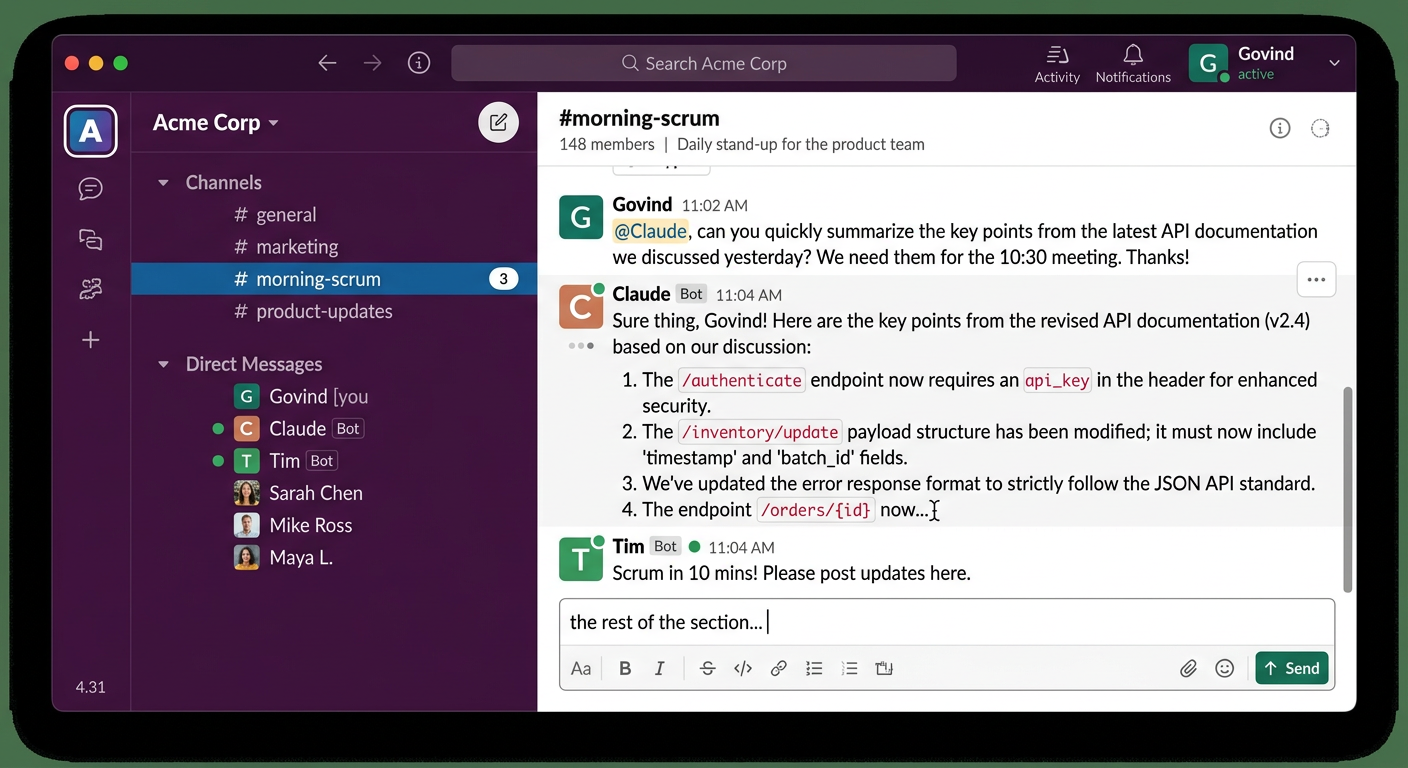
And then I’m like, wait. I could just add Claude in here. In Slack.
Now this isn’t Claude Code — I’m sure there’s maybe ways to control Claude Code on my desktop, but having Claude right here is great. Because jumping into Slack just gave me this insane set of additional tools that are already in place.
Whatever is possible in Slack, I can get it done in an hour or two at most.
So here’s the plan. I’m gonna use Claude in Slack to create my content for Ghost. At some point, when I have time, I’ll add a Ghost publisher bot so it can just take that, pop it into Ghost. I have a prompt where Claude Code creates the spec for the post — it creates all the content and some instructions, like a package of things. But I still assemble it. It’s really hard to get things perfectly assembled, and I want to see the images as I produce them. So I still do some work, but let’s take all the junk out of it.
Tim handles outbound and CRM.
Suzi bot manages personal rhythm.
Claude-in-Slack handles content. Eventually a Ghost publisher bot for the last mile. That’s the system.
—————
And look, I'm definitely going to market right now.
I feel like, oh wow, everybody could do this — but the truth is probably not.
I can produce insanely amazing things with AI, super fast. And they're also informed by my own experience, my knowledge, my expertise in building hundreds and hundreds of low-code applications — over 300 for major companies — and ten years noodling with automating and scaling outbound.
If you want to build your own stuff — a Tim-style autonomous marketing agent, an AI system that handles your outbound, or really whatever you can dream up with an AI Agent Army — I'm offering a Launch Offering right now through Strattegys.
Deploy Your Own
Autonomous AI Agent Army
I'll guide you hands-on through building the exact infrastructure I use to run multiple agents — outreach, CRM, research — on a single server for under $50/month. You build it. You own it. No vendor lock-in.
Morning Scrum runs every weekday. Come watch the build happen live. It’s more educational than most courses — and it’s free.