Blueprint for the AI Sales Revolution
What happens when a business strategist who built a 75-person company meets an automation engineer who ships AI workflows for $5 in API credits? Magic — and a very honest conversation about LinkedIn, N8N, and the future of AI-powered sales.

ARTICLE — BLUE CORE AUTOMATION / THE SARAH FACTOR
Two Builders Walk Into a Live Stream: What Happened Next Is a Blueprint for the AI Sales Revolution
A conversation between Govind Davis and Tanvir Rahman reveals the messy, brilliant, very-much-in-progress future of AI-driven business development.
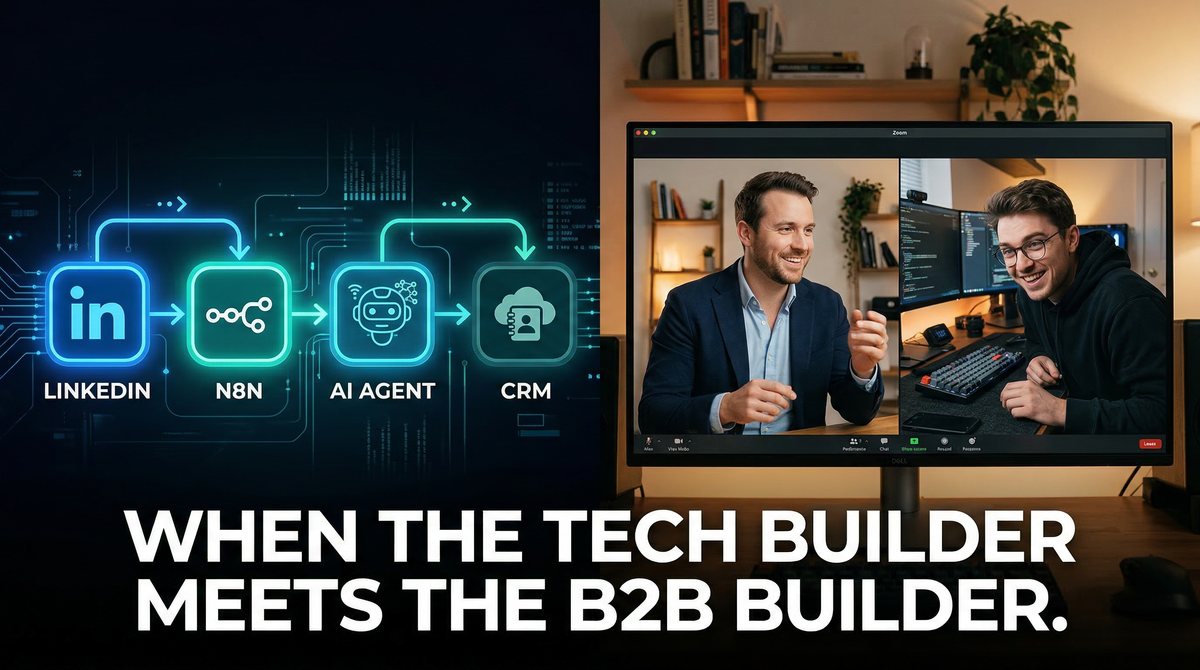
Nobody plans the best conversations. They just happen — usually when two people who each know half of something finally sit down together. That's exactly what went down on a recent morning scrum livestream when Govind Davis, a seasoned business strategist and founder of Cetacean Labs, invited Tanvir Rahman, an N8N automation specialist from Bangladesh, onto his show. What unfolded was part tech demo, part brainstorm, and entirely the kind of raw, unscripted exchange that actually moves the needle.
The session was technically a "Morning Scrum." In reality, it was something closer to a live architectural review of the future of AI-driven sales — with a glitchy virtual background and zero filter.
The Problem Worth Solving
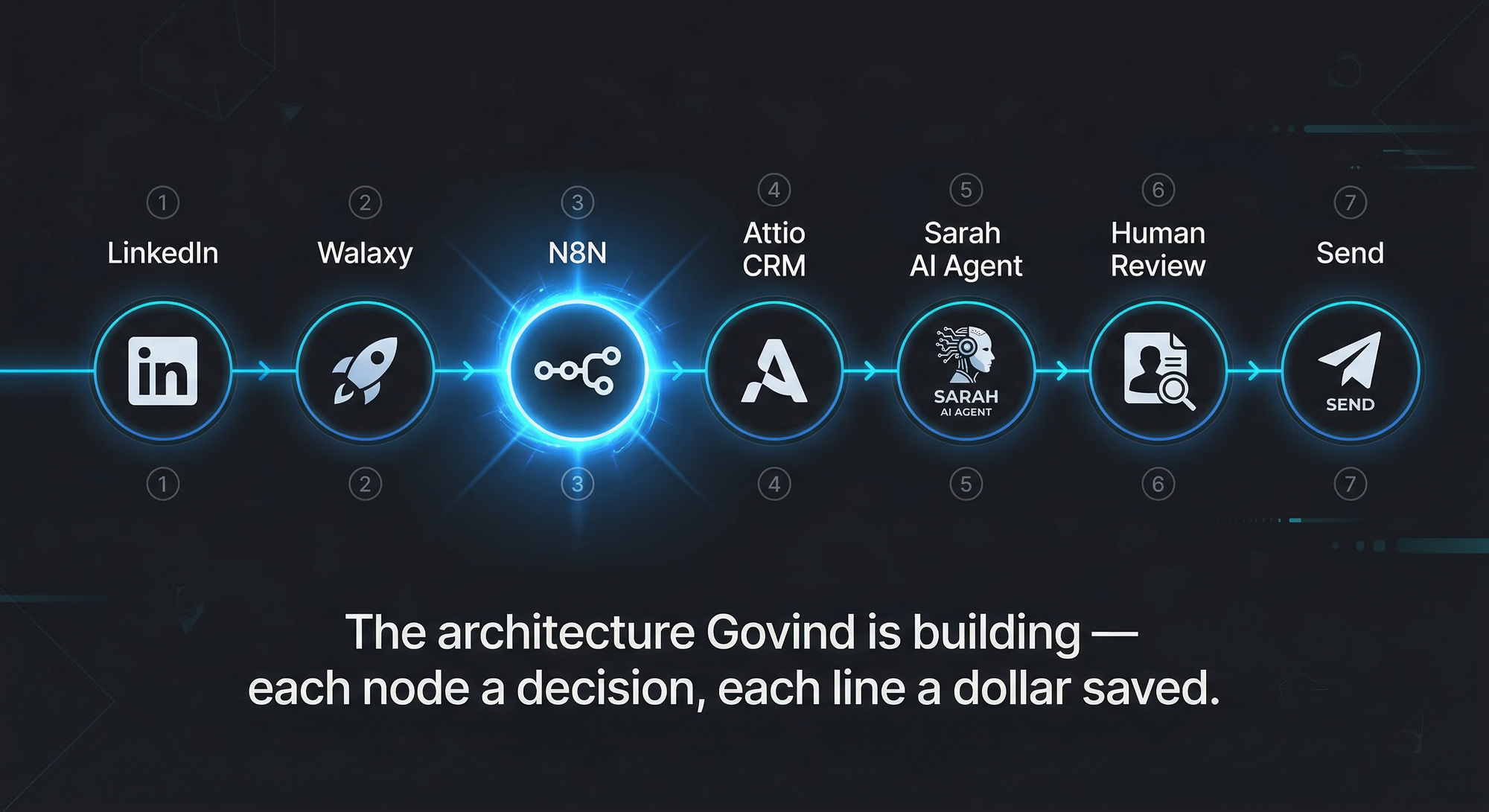
Govind had built something called Sarah — an AI agent designed to sit inside a LinkedIn outreach workflow and do the cognitively exhausting middle work: read an incoming message, understand the context, and draft a personalized reply grounded in brand materials and campaign strategy. The vision was sharp. The execution? Still a few wires short of sparking.
Here's the pipeline he was wrestling with: Waalaxy (a LinkedIn automation tool) sends outreach messages on the front end. Replies come in. A tool called SyncIn scrapes those replies and posts them as notes inside Attio, his CRM. A webhook then fires off to Sarah, which generates a suggested reply. Then Govind reviews, edits if needed, and hits send. Simple in theory. In practice, every junction in that chain was a potential leak.
"I'm spending $30 a month on SyncIn just to get messages into Attio," Govind admitted, with the kind of transparency that most people save for their accountant. "I want to fix that. But I also want it to be reliable." That's where Tanvir came in.
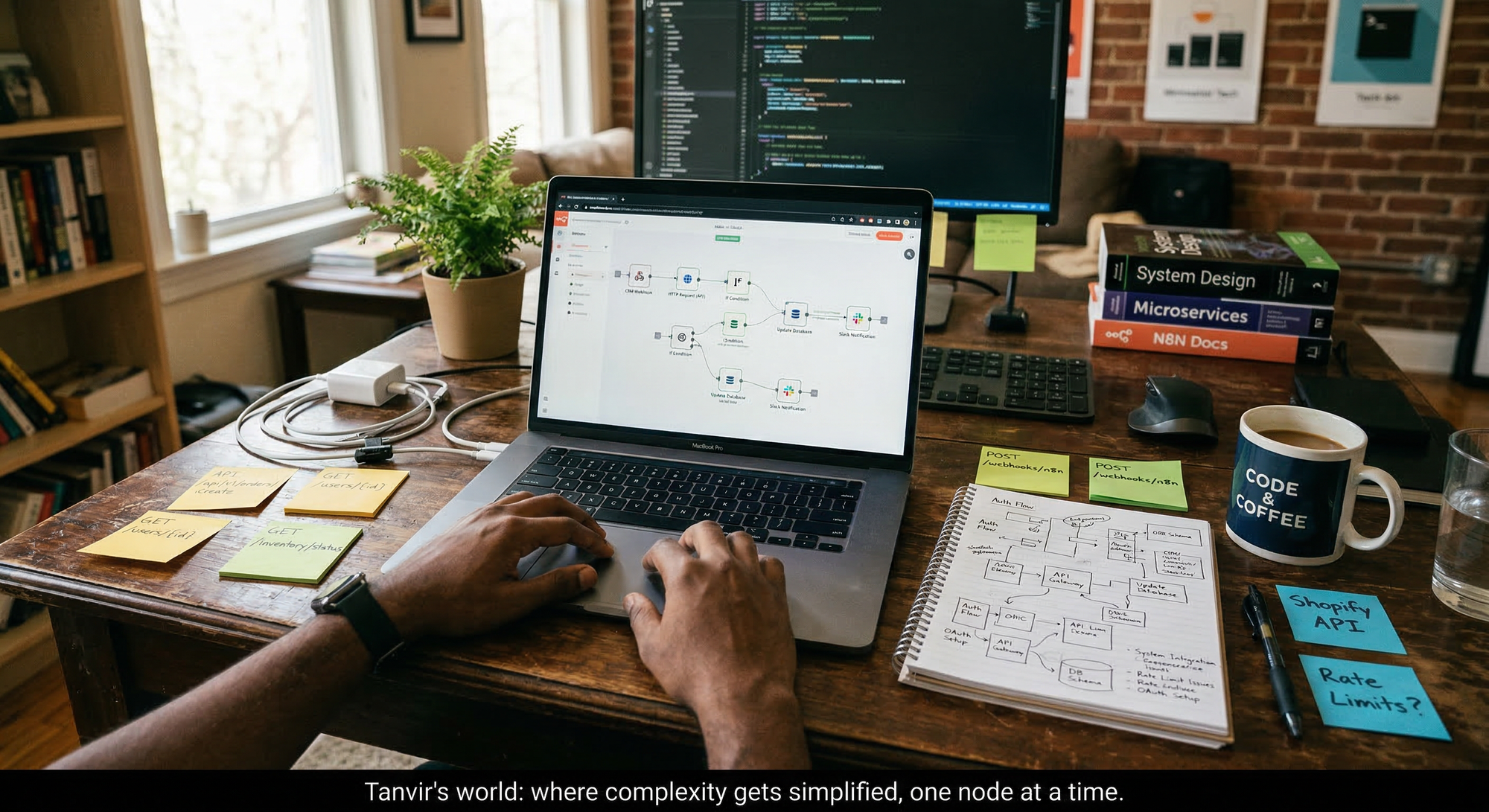
Tanvir Rahman is the kind of technical mind that makes business owners simultaneously relieved and slightly embarrassed — relieved because the problems they've been overthinking have elegant solutions, embarrassed because those solutions are often simpler than expected. His LinkedIn bio says it plainly: "AI Automation | Helping business owners save time by automating repetitive tasks with N8N." What it doesn't say is that his philosophy is almost Zen in its focus: do less, better.
When Govind walked him through the Sarah architecture, Tanvir's first instinct wasn't to add complexity — it was to interrogate necessity. "What are the inputs? What are the outputs? What does the CRM actually need?" He was already mentally cutting the workflow down to its load-bearing bones.
His approach with clients mirrors this ethos. Rather than locking them into black-box systems where costs and processes are invisible, Tanvir insists that clients own their own N8N instances, their own API keys, their own visibility. "I don't want anyone saying, 'the system is taking too much money and I don't know why,'" he explained. "There's real transparency between you and me." In a world of SaaS subscriptions and hidden markups, that philosophy is quietly radical.
The Technical Meat
The crux of the conversation landed on a deceptively thorny problem: how do you reliably pull messages out of LinkedIn and pipe them into an automation workflow? LinkedIn's official API is famously limited — it mostly lets you create posts, which is about as useful here as a snow shovel in July. For messaging, you need a workaround.
Govind had zeroed in on Connect Safely, a platform that offers a LinkedIn messaging API as an add-on for roughly $10/month on top of their base plan. The idea: N8N polls the API on a schedule — every minute, every five minutes — picks up new messages, routes them to Attio, and simultaneously fires a webhook to Sarah for response generation. Tanvir, characteristically, wanted to see the docs before committing to an opinion. No native N8N integration? Fine — HTTP request nodes exist for exactly this. But he wanted to be certain before he promised anything.
"I think it's possible, but I've never tried this," he said — a sentence that carries more professional integrity than a dozen confident guarantees ever could. "Things can fail. Things can go anywhere in between." He wasn't being pessimistic; he was being an engineer.
The Bigger Picture They're Both Painting
Pull back and the real story snaps into focus. Govind isn't just trying to save $30 a month on SyncIn. He's building an AI-powered BDR (Business Development Representative) — a system where the machine does the heavy cognitive lifting of drafting personalized follow-ups, and the human stays in the loop for final approval before anything hits send. It's an important distinction. This isn't about replacing human judgment; it's about removing the grunt work that exhausts it.
Govind has the receipts to prove the model works when executed well. For a previous client, Strikedeck, his LinkedIn-driven outreach strategy generated over 20,000 connections and 1,259 leads — results significant enough that the company was acquired twice during the campaign period. The content and strategy side? He's got that locked. What he needs is the technical infrastructure to scale without it cracking under pressure.
Tanvir, meanwhile, brings the infrastructure instincts. His current project — an automation system he's been running on roughly $5 in API credits over four days — demonstrates exactly the kind of efficient, thoughtful architecture that Govind's Sarah platform needs underneath it. Where Govind sees opportunity and outcome, Tanvir sees data flow and failure modes. Together, the coverage is nearly complete.
What This Conversation Really Was
Govind closed the session by putting a partnership offer on the table — not with a contract, but with a handshake-level conversation. He's building out "The Sarah Factor," a weekly show exploring AI-driven sales and BDR automation. He wants Tanvir as the resident technical voice: the integration guy, the one who keeps the ambition tethered to what's actually buildable.
It's a smart pairing. Govind's superpower is narrative — he can see the arc of a campaign, the story behind a product, the 20,000-connection outcome of a well-executed strategy. Tanvir's superpower is precision — he can map data from A to B without leaking a dollar or a record along the way. One thinks in outcomes. The other thinks in systems. Both are necessary.
For anyone building in the AI sales automation space right now, this conversation is a useful mirror. The technology is close. The APIs exist. The workflows are architectable. What's still rare is the combination of strategic clarity and technical honesty that both of these builders brought to a Tuesday morning livestream that probably had about twelve viewers and will quietly influence the next hundred projects built by the people who watched it.
That's how the good stuff travels. Not in viral moments — in conversations that make the right people think harder.
Tanvir Rahman is the founder of Blue Core Automation, an N8N-based automation consultancy helping business owners eliminate repetitive tasks and scale intelligently. Connect with him on LinkedIn.
Govind Davis hosts The Sarah Factor, a weekly show on AI-powered sales automation.